
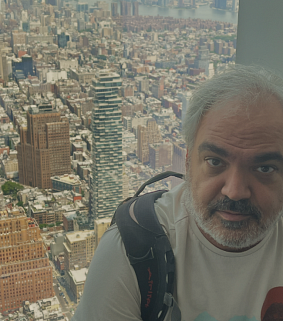
In junior high, my school received a batch of Apple IIe computers. Using Applesoft BASIC, I wrote a routine where a cluster of pixels shaped like an airplane dropped a cluster of pixels shaped like a bomb onto a cluster of pixels shaped like a jeep. It was pretty amazing, let me tell you. A few years later, we were laying out our high school newspaper on an Apple Macintosh. The thread was already there — I just didn't know where it was leading yet.
After high school I joined the Navy, operating a mobile nuclear-powered steam plant and circumnavigating the globe before returning stateside with a clearer sense of what I wanted. I headed back to Montana State to finish what I'd started at the University of Montana in Missoula. Geographic information systems caught my attention — the idea of combining mapping and computation felt like exactly the kind of problem worth spending time on. I finished a BA in Environmental Studies, then moved to San Diego for a master's degree in Geographic Information Science. That's where I did my first Linux install, and something clicked. My thesis was written entirely with free and open source software: LaTeX for typesetting, Python and R for analysis and visualization, all stitched together with Make. The tools felt honest.
I followed my thesis advisor to Phoenix, collaborating on academic papers and projects, eventually managing a couple of Mac labs and setting up my own DeployStudio server to automate imaging and deployment. The jump to Linux infrastructure at Arizona State University felt natural from there. I spent eight years helping migrate data centers to the AWS cloud, and when the opportunity came to trade the heat of central Arizona for the Pacific Northwest, I didn't hesitate.
Today I work in Core Infrastructure - Systems Automation Services at UO, managing over 500 Linux nodes using Puppet Enterprise. If you've never heard of Puppet, think of it as a language for describing how a computer system should look — and then having that description enforced automatically, at scale, across an entire university. The craft of it is what keeps me engaged. Writing a good Puppet module is a bit like writing a good essay: the logic should be clear, the structure should be clean, and someone reading it later should be able to follow your thinking without asking you questions. Every day offers some new opportunity to improve how the systems work or to fabricate an entirely new solution to a problem that didn't have one yesterday.
Working at UO has been a good match. There's enough scale here to make the work genuinely interesting, and enough autonomy to approach problems the right way rather than just the fast way. Higher education IT has a rhythm to it that suits me — the mission matters, the problems are real, and the people tend to care about doing things well.
If you're thinking about applying to UO, my advice is simple: follow your curiosity. My own path wound from BASIC programming to nuclear engineering to cartography to Linux systems administration, and every turn made sense in context, even if it wouldn't have on paper. The skills you pick up along strange routes tend to be the ones that make you useful in ways nobody anticipated.
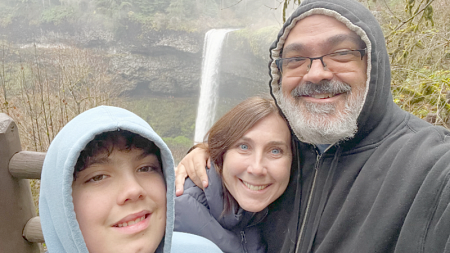
Outside of work, I live in Eugene with my better half, Michelle Stuckey, Director of Composition in the English department, and son, Elliot, who is heading to Churchill high school next fall. I play Fortnite, throw frisbees, and still think Led Zeppelin and Pink Floyd between them covered most of the ground worth covering. Blade Runner remains the film to beat. My other strong opinions: pizza is ideal, dogs are correct, autumn drives are underrated, and a good nap is never wasted.
(April 2026)